- October 18, 2024
Summarize with AI
Not enough time? Get the key points instantly.
Get summary:
Introduction
Bluetooth AoA (Angle of Arrival) helps locate devices by measuring the angle of Bluetooth signals as they reach a receiver with multiple antennas. Part of Bluetooth 5.1, it is used for accurate tracking in places like warehouses or malls, enabling efficient navigation and asset management.
It uses multiple antennas to measure the angle at which signals arrive, allowing for precise location tracking indoors. Unlike traditional methods based on signal strength, AoA analyzes phase differences between signals received at each antenna, a more accurate way to pinpoint device locations.
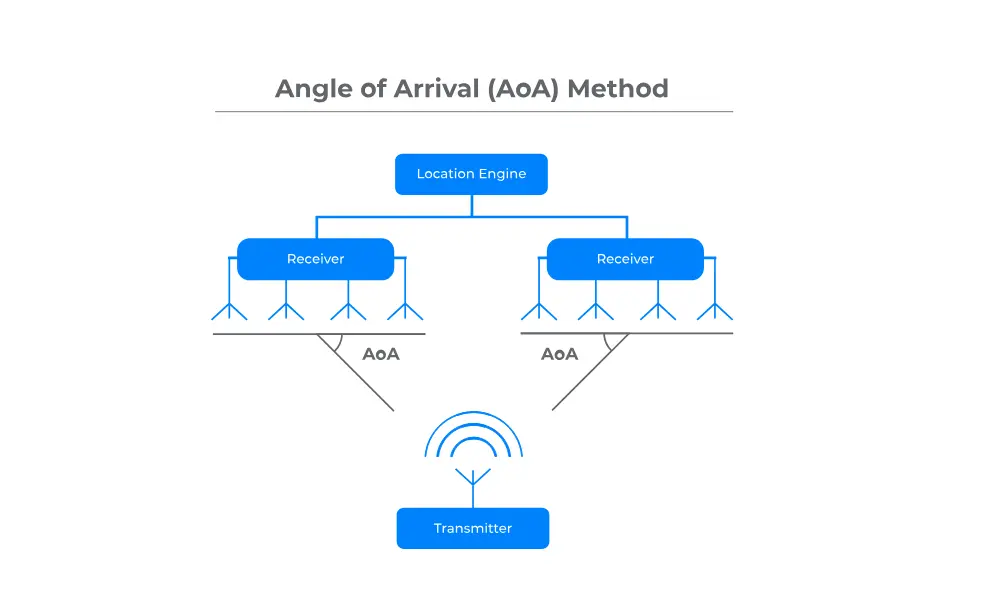
How Does Bluetooth AoA Work?
The working principle of Bluetooth AoA involves several key steps:
Signal Transmission:
A Bluetooth device (like a tag) transmits a signal using a single antenna.
Signal Reception:
A receiving device (often called a locator or anchor) equipped with multiple antennas captures this signal.
Phase Difference Measurement:
As the signal reaches each antenna, it experiences slight delays due to the different distances from the transmitter to each antenna. These delays create phase differences.
Angle Calculation:
The locator analyzes these phase differences to calculate the angle of arrival of the signal. By using multiple locators, it can triangulate the exact position of the transmitting device.
Bluetooth AoA allows for high-precision location tracking, achieving accuracy levels as fine as 0.1 to 1 meter.
Applications of Bluetooth AoA :
Bluetooth AoA has numerous applications across various industries:
Retail:
Stores use AoA for customer tracking and personalized marketing. By understanding customer movements, retailers can optimize store layouts and enhance shopping experiences.
Healthcare:
Hospitals implement AoA for asset tracking, ensuring critical equipment is easily located and reducing time spent searching for tools.
Manufacturing:
In factories, AoA helps track tools and inventory in real-time, improving operational efficiency and minimizing downtime.
Hospitality:
Hotels use AoA to enhance guest services by tracking preferences and movements within their premises.
Examples of Bluetooth AoA Implementation
Several real-world examples illustrate how Bluetooth AoA is being used:
Asset Tracking in Warehouses:
An automotive manufacturer employs Bluetooth AoA to monitor tools on assembly lines. By deploying beacons on assets and using AoA receivers throughout the facility, they achieve real-time visibility into their inventory.
Indoor Navigation Systems:
Retailers utilize Bluetooth AoA to guide customers through stores, providing directions to products based on their location within the store.
Event Management:
During conferences or large events, organizers can track valuable equipment and ensure efficient handling through Bluetooth AoA technology.
How Can Bluetooth AoA Be Implemented?
Implementing Bluetooth AoA involves several steps:
Infrastructure Setup:
Install multiple Bluetooth AoA receivers in the area where tracking is needed. These receivers should be strategically placed to cover the entire space effectively.
Device Integration:
Equip assets or devices with Bluetooth tags that support AoA technology.
Software Development:
Develop or integrate software that can process the signals received by the locators and calculate positions based on the angle of arrival data.
Testing and Calibration:
Conduct tests to calibrate the system for accuracy and ensure reliable performance in real-world conditions.
How Bluetooth AoA is better than BLE? Here are some points in which AoA excels BLE.
Bluetooth AoA is better than BLE in precision and accuracy ,Real-time data processing, battery life.
Higher Accuracy:
- AoA achieves location accuracy of 0.1 to 0.5 meters.
- Standard BLE typically offers accuracy of 5 to 10 meters.
3D Positioning:
- AoA enables tracking in three dimensions (horizontal and vertical).
- Useful in multi-story buildings for precise floor identification.
Signal Processing:
- AoA uses an array of antennas to measure the angle of incoming signals.
- Standard BLE relies on Received Signal Strength Indicator (RSSI), which can be affected by obstacles.
Real-Time Data:
- AoA provides higher refresh rates for location updates.
- Enhances real-time tracking capabilities compared to standard BLE.
Utilization of Existing Infrastructure:
- AoA can enhance current Bluetooth setups, making it cost-effective.
- Compatibility with standard BLE devices allows broader application.
Low Power Consumption:
- Both technologies are low power, but AoA efficiency contributes to longer battery life.
Versatile Use Cases:
- AoA is ideal for high-precision needs in healthcare, retail, and logistics.
- Traditional BLE is often limited to basic proximity detection.
Enhanced Security Features:
- Precise tracking with AoA allows for better monitoring of sensitive assets.
Conclusion
Bluetooth Angle of Arrival technology significantly enhances indoor positioning systems by providing accurate location tracking through innovative signal processing techniques. Its applications span various industries, demonstrating its versatility and effectiveness in improving operational efficiency and user experiences. The deployment of AoA technology can facilitate more efficient resource management, improved user experiences, and enhanced safety in various environments.
Author
Have Something on Your Mind? Contact Us : info@corefragment.com or +91 79 4007 1108

Related articles