Use Cases:
- Need of whole document reading is reduced
- Frequent user doubts related to particular document can be resolved by bot
- User experience improved when bot clear their doubts irrespective of admin availability
- Information access becomes faster
RAG based chatbot is able to answer user queries related to documents uploaded by admin. The client wanted to automate document related queries of users. CoreFragment developed custom chatbot that can support upto 500 documents at a time with 40k tokens storage capacity in memory for context retrival.
Europe
AI and ML






CoreFragment Technologies has expertise and experience in RAG architecture, LLM development and custom AI product development.
RAG is powerful but not the right solution for every chatbot requirement. CoreFragment helps you assess your use case — document volume, query types, privacy requirements, response accuracy expectations and recommends the right architecture. Sometimes RAG is the answer. Sometimes a fine-tuned model or a hybrid approach works better. We give you an honest evaluation, not a sales pitch.
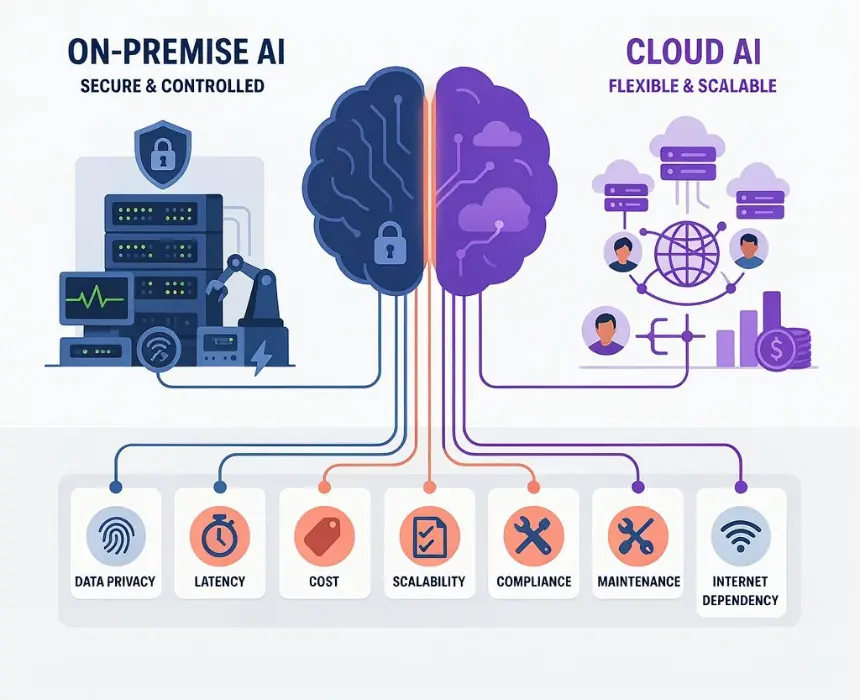
If your documents contain confidential business data, patient information, legal content, or anything that cannot go to a third-party AI API, CoreFragment helps you deploy a fully on-premise RAG system using locally hosted LLMs. Your documents stay on your servers. Your queries never leave your network. You still get the full power of AI-driven document search.
Hallucination is the biggest risk in AI chatbots for business use. CoreFragment builds RAG systems with retrieval confidence thresholds, fallback responses for low-confidence queries, and source citation features, so your chatbot only answers when it has reliable context, and tells users honestly when it does not.
Whether you are starting with 50 documents or planning for 5,000, CoreFragment builds your RAG system on a vector database architecture and cloud infrastructure that scales without requiring a redesign. You start lean, validate with real users, and expand confidently knowing the foundation supports where you are going.
If your team or your customers spend time searching through manuals, reports, policies, or product documents for answers — we can help you build a RAG chatbot that does that searching for them. You upload the documents. Your users ask questions in plain language. The chatbot finds the right answer from the right document in seconds.
When a user asks a question, the system breaks it into chunks and runs a semantic search across all stored document embeddings in the vector database. It finds the most contextually relevant sections, not just keyword matches and passes them to the LLM as context. The LLM then generates a natural, accurate response based on that retrieved content, rather than making up an answer from general training.
A regular chatbot answers from pre-programmed responses or general AI training data. A RAG (Retrieval-Augmented Generation) chatbot goes a step further - it retrieves relevant information from your own documents and uses that as context to generate accurate, specific answers. This means the chatbot does not guess or hallucinate , it answers directly from your uploaded content, making it far more reliable for business use cases.
RAG systems typically support PDFs, Word documents, text files, CSVs, and other structured or unstructured text formats. The documents are parsed, chunked, and indexed automatically after upload. The specific formats supported depend on the parsers integrated during development, which can be customized based on your document types.
The system can be configured to detect low-confidence retrieval, where no relevant document chunks are found and respond accordingly, telling the user that the information is not available in the current document library rather than generating an inaccurate answer. This is an important guardrail that prevents misinformation.
Yes. The semantic search retrieves relevant chunks from across the entire document library, not just from a single file. If a user question spans multiple documents, the system pulls the most relevant sections from each and combines them as context for the LLM to generate a comprehensive answer.