- June 16, 2026
Summarize with AI
Not enough time? Get the key points instantly.
Get summary:
What Happens if You Choose the Wrong BLE SoC?
Your IoT product idea is approved. The use case is clear - a fitness tracker, a smart industrial sensor, a connected medical device, or a home automation gadget. But somewhere early in the hardware conversation, your team hits the question that shapes everything else: which Bluetooth chip are we building on?
Get it wrong and you find out the hard way - a device that drains the battery in four days instead of four weeks, a connection that drops on half the Android phones in your test group, or a chip that's discontinued before your second production run. This post walks you through how to choose a BLE SoC for your IoT product, and compares the four vendors most product teams end up evaluating: Nordic Semiconductor, Espressif, Texas Instruments, and Silicon Labs.
Why the Chip Vendor Matters as Much as the Chip
A BLE chip is not just a component - it's a platform decision. Along with the chip, you're choosing the software tools your firmware team will use, the community they'll lean on when things break, the update mechanism that keeps your product current in the field, and the vendor relationship that either supports or slows down your production lifecycle.
The wrong chip with strong tooling and a large developer community will ship faster than a better-specced chip with poor documentation. That's a real trade-off, and most product teams underestimate it until they're three months into development.
The good news: all four vendors covered here make solid chips. The decision comes down to what your specific product needs.
Four Questions to Answer Before Comparing Vendors
These four questions will eliminate two or three vendors before you even look at a datasheet.
1. How is your device powered? A product plugged into the wall or recharged nightly has very different chip requirements than one running on a small battery for a year or more. Battery life is the single biggest factor in narrowing down your options.
2. Does your product need Wi-Fi as well as Bluetooth? Some products only need Bluetooth to talk to a phone. Others need Wi-Fi to connect to a cloud server directly. If your device needs both, that eliminates some vendors and makes others obvious choices.
3. What smart home ecosystem are you targeting? Matter, Zigbee, and Thread are the dominant smart home protocols right now. If your product needs to work inside one of those ecosystems, the chip needs to support it natively.
4. What is your target unit cost? A $0.50 difference per chip at 50,000 units per year is $25,000 annually. That number matters when you're scaling.
With those four answers in hand, here is what each vendor actually offers.
Nordic Semiconductor - Best for Battery-Powered Products
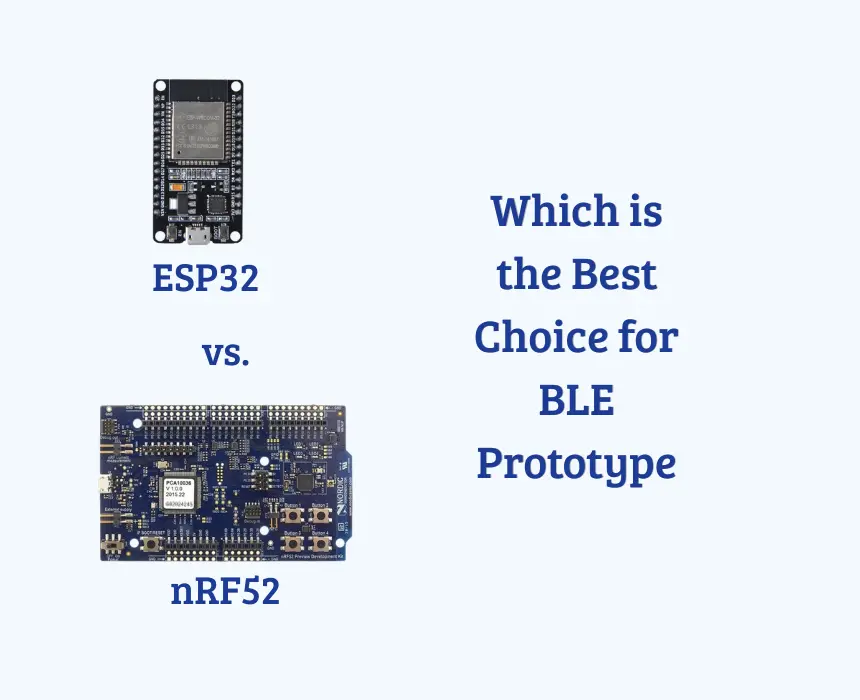
Nordic is the most widely used BLE chip vendor for products that run on batteries - wearables, health monitors, environmental sensors, and asset trackers. Their chips are known for exceptionally low power consumption when the device is idle, which is most of the time for a battery-powered product.
What Nordic does well:
Best battery life among the four vendors - their chips draw very little power when the device is in sleep mode, which is critical for products that need to last weeks or months on a charge
Mature, well-supported developer tools with one of the largest BLE communities in the world - your team will find answers fast
Straightforward path for sending software updates to devices already in the field (over-the-air updates), which is something every IoT product eventually needs
A clear, long-term product roadmap - Nordic chips tend to stay in production for years, which reduces the risk of your chip going discontinued mid-product lifecycle
Where Nordic falls short:
Higher unit cost than Espressif - noticeable on high-volume, price-sensitive products
No built-in Wi-Fi - if your product needs both Bluetooth and Wi-Fi, you'll need a second chip
Best fit: Wearables, health and medical devices, battery-powered sensors, any product where battery life is a core selling point.
Espressif - Best for Wi-Fi + Bluetooth on One Chip
Espressif makes the ESP32 family, which is arguably the most popular IoT chip in the world for products that need Wi-Fi and Bluetooth together. If you have ever bought a smart plug, a connected thermostat, or a basic home sensor device, there is a good chance it runs on an ESP32.
What Espressif does well:
Wi-Fi and Bluetooth on a single chip - eliminates the cost and complexity of adding a separate Wi-Fi module
Lowest unit cost of the four vendors - by a meaningful margin at volume
Massive developer community and extensive documentation - faster to get started than almost any other platform
Newer models like the ESP32-C6 also support Thread and Zigbee, making them viable for smart home products targeting the Matter ecosystem
Where Espressif falls short:
Battery life is the weak spot - the ESP32 family consumes noticeably more power in sleep mode compared to Nordic or TI. For devices that run on a small battery for months without recharging, this is often a dealbreaker
Best suited for rechargeable or mains-powered products
Best fit: Smart home devices, gateways, cloud-connected products, rechargeable IoT devices, any product where unit cost is the top priority and Wi-Fi connectivity is needed.
On one connected home sensor project, the team chose the ESP32-C3 specifically because the device recharged every night. Battery life was not the constraint, and having Wi-Fi and Bluetooth on one chip made the hardware design simpler and cheaper.
Texas Instruments - Best for Industrial and Long-Lifetime Products
TI's BLE chips (the CC2340 and CC2652 families) are built for the demanding end of IoT - industrial environments, building automation systems, infrastructure sensors, and medical-grade devices that need to keep running reliably for 5 to 10 years.
What TI does well:
Strong multi-protocol support - one chip can handle Bluetooth, Zigbee, and other wireless protocols, which matters for industrial products that need to talk across different networks
Excellent battery life, close to Nordic levels - well-suited for sealed or hard-to-reach sensors that can't be serviced regularly
TI's enterprise-grade vendor support - dedicated technical account managers, longer product longevity guarantees, and deep reference design libraries that speed up development for complex products
Built-in security features that meet the requirements of medical and industrial certifications
Where TI falls short:
Smaller developer community than Nordic or Espressif - finding answers to niche problems takes longer
Steeper learning curve - TI's development tools are powerful but less beginner-friendly
Higher unit cost, similar to Nordic - justified for industrial use cases, harder to defend for consumer products
Best fit: Industrial sensors, building automation, medical devices, infrastructure products with long deployment lifetimes, any product where vendor support and reliability over a decade matters more than unit cost.
Silicon Labs - Best for Smart Home and Matter Products
Silicon Labs (their chips are called EFR32, or "Wireless Gecko") has positioned itself squarely in the smart home space. If your product needs to work inside the Matter, Zigbee, or Thread ecosystems - the protocols that make different smart home devices talk to each other - Silicon Labs is the most complete option.
What Silicon Labs does well:
The strongest out-of-the-box support for Matter, Zigbee, and Thread - all under one development framework, which significantly reduces development time for smart home products
Strong certification and compliance support program - Silicon Labs actively helps customers navigate the regulatory and interoperability testing process, which is a real time-saver
Solid battery life, competitive with Nordic for most smart home accessory use cases
Active community and good documentation specifically in the smart home segment
Where Silicon Labs falls short:
The community and ecosystem is narrower outside of smart home - less useful for general BLE-only or industrial IoT products
Higher unit cost than Espressif; comparable to Nordic and TI
Best fit: Smart home accessories (door locks, plugs, sensors, lighting), commercial building automation, any product targeting Matter or Zigbee certification.
Nordic | Espressif | Texas Instruments | Silicon labs | |
|---|---|---|---|---|
Battery Life | Best-in-class | Not for long battery life | Excellent | Very Good |
Wi-Fi Support | No | Yes (built-in) | No | No |
Smart Home Protocols | Partial (Thread) | Partial (C6 model) | Partial | Full (Matter, Zigbee, Thread) |
Unit Cost | Medium-high | Low | Medium-high | Medium-high |
Developer community | Very large | Very large | Medium | Medium |
Industrial/medical grade | Good | Basic | Best | Good |
Best for | wearables, sensors, medical | Rechargeable IoT, Wi-Fi devices | Industrial , long lifetime | Smart home, Matter Products |
How to Pick: A Simple Decision Guide
Your device runs on a battery that lasts weeks or months without recharging → Nordic or TI. Battery life is the core constraint. Nordic is the safer starting point for most teams; TI if you're building for industrial or medical.
Your device connects to Wi-Fi as well as Bluetooth → Espressif. Having both radios on one chip is cleaner, cheaper, and simpler to certify than adding a second Wi-Fi module.
Your device needs to work inside a smart home ecosystem (Matter, Zigbee) → Silicon Labs. The protocol support and certification tooling are the most complete in the market.
Your device needs to work for 7–10 years without hardware changes → TI. Their longevity commitments and enterprise support infrastructure are built for exactly this.
You need the lowest possible chip cost at volume → Espressif. For rechargeable or plugged-in products, the cost difference is hard to ignore.
A Checklist Before You Commit
Battery life requirement confirmed and tested against the chip's real-world power draw, not just the datasheet
Wi-Fi requirement confirmed: does this device connect to the internet directly, or only to a phone?
Smart home ecosystem requirement confirmed: Matter, Zigbee, Thread, or none?
Unit cost modeled at your real year-one production volume
Developer team has evaluated the tooling on a development board - not just read about it
Chip longevity confirmed - vendor has a clear product roadmap past your expected launch + 3 years
A backup chip option identified within the same vendor family in case of supply issues
Match the Chip to the Product, Not the Other Way Around
The four vendors here each do something genuinely well. Nordic keeps batteries alive longer. Espressif makes Wi-Fi + Bluetooth affordable. TI supports products that need to run reliably for a decade. Silicon Labs makes the smart home ecosystem accessible. None of them is the right choice for every product - which is exactly why the question to start with is "what does my product need?" not "which chip is most popular?"
If you're working through this decision and want an outside perspective from a team that has built IoT products across Nordic, Espressif, and TI platforms - CoreFragment can review your requirements and give you a direct recommendation on vendor, chip family, and development approach.
Author
Have Something on Your Mind? Contact Us : info@corefragment.com or +91 79 4007 1108

Related articles