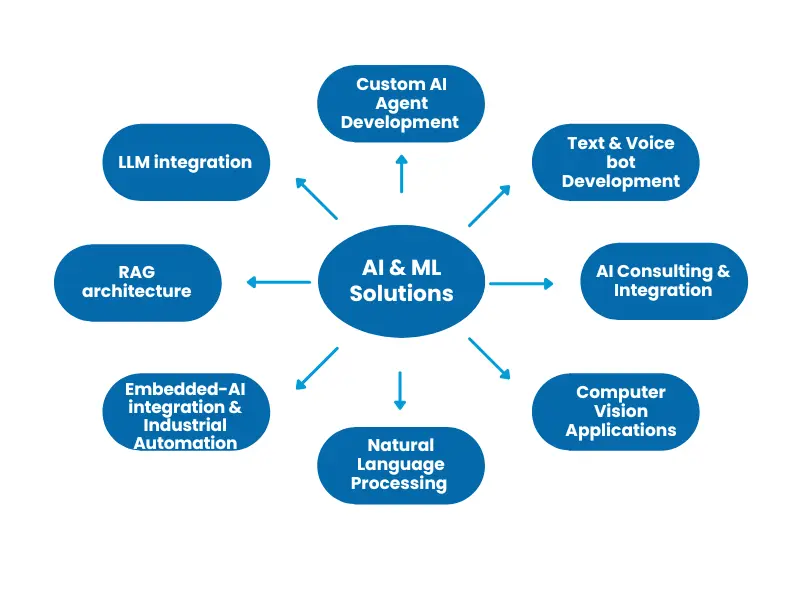
Our AI development services include machine learning model development, LLM integration, and computer vision applications. We build custom AI solutions with TensorFlow, PyTorch, and OpenAI APIs. From chatbots to predictive analytics, we deliver AI systems that solve real business problems.
As an AI development company, Corefragment specialize in NLP, RAG-based systems, and deep learning implementations. Our engineers train custom models, fine-tune LLMs, and deploy AI to production environments. We have built AI solutions for healthcare diagnostics, industrial automation, and customer service.
We specialize in computer vision, sentiment analysis, and generative AI integration. Your product needs AI models that are accurate, scalable, and cost-effective to run. We provide model training services, API development, embedded-AI integration, cloud deployment, and ongoing optimization.

Corefragment Technologies are specialized in integrating machine learning and artificial intelligence to existing devices to make it intelligent.
Most AI projects that fail do not fail because of bad engineering - they fail because the wrong problem was selected, the wrong model approach was chosen, or the deployment environment was not considered during design. We run structured AI consulting engagements covering use case prioritisation based on data availability and business impact, model selection between open-source, commercial API, and custom-trained options with honest trade-off analysis, data readiness assessment identifying gaps that need to be addressed before training can begin, architecture design for the full AI system including data pipeline, model serving, and monitoring, and PoC development to validate technical feasibility before a full engagement begins.
Most ML projects fail not because of model quality but because of the gap between a notebook experiment and a production system that receives real data, updates over time, and feeds decisions that matter. We run the full ML lifecycle - data assessment and feature engineering, model selection and training across supervised, unsupervised, and reinforcement learning approaches, evaluation against business metrics not just accuracy scores, deployment through REST APIs and batch pipelines, and ongoing monitoring with automatic retraining triggers when model performance drifts. We have built ML models for demand forecasting, churn prediction, fraud detection, recommendation engines, risk scoring, and predictive maintenance across a range of industries.
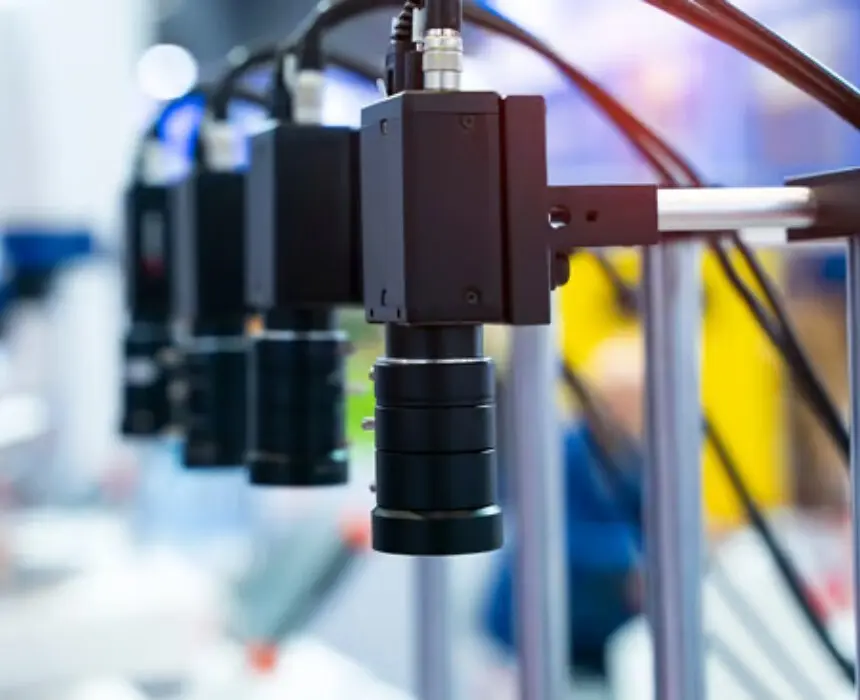
Computer vision models that work on curated benchmark datasets frequently underperform on real deployment data - different lighting conditions, camera angles, object occlusion, and image quality variations that were not in the training set. We build computer vision systems with production deployment in mind: data collection and augmentation strategies that anticipate real-world variation, model architectures selected for the accuracy-latency trade-off your deployment target requires, and post-training optimisation using quantisation and pruning for on-device and edge deployment. We have built object detection, image classification, instance segmentation, OCR, facial recognition, defect detection, and video analytics systems for industrial, retail, medical imaging, and security applications.
NLP applications - document processing, sentiment analysis, entity extraction, classification, and conversational interfaces - are where language models deliver the most direct and measurable business value. We build NLP systems covering document intelligence pipelines that extract structured data from unstructured text at scale, sentiment and intent classification models trained on domain-specific data, named entity recognition systems for legal, medical, and financial document processing, and conversational AI systems that go beyond FAQ matching to handle multi-turn dialogue, context tracking, and business process integration. We deploy NLP models as APIs, embedded modules, and batch processing pipelines depending on your throughput and latency requirements.
Building a model is half the work. Getting it into a product, a device, or an operational system where it actually changes a decision or automates a task is the other half and it is where most AI projects stall. We deploy models as REST and GraphQL APIs, streaming inference endpoints, batch scoring pipelines, and on-device embedded modules depending on your latency, throughput, and connectivity requirements. We integrate AI into web and mobile applications, IoT platforms, embedded hardware, and enterprise systems - handling versioning, graceful failure, and latency management so the AI layer works as part of the product rather than as a fragile add-on. We have deployed AI across cloud, edge, and MCU-level hardware and understand the architectural constraints at each layer.
Generative AI delivers value when the model is built around the specific knowledge, tone, and task requirements of the business using it — not when it is an off-the-shelf API with a thin prompt wrapper. We build generative AI systems covering LLM fine-tuning on domain-specific datasets using LoRA and QLoRA techniques, Retrieval-Augmented Generation pipelines that ground model outputs in your actual knowledge base, AI agent systems that take multi-step actions using tool calling and function execution, and evaluation frameworks that measure whether the model does what your business actually needs. We work with open-source models including LLaMA, Mistral, and Phi alongside OpenAI, Anthropic, and Google APIs — selecting based on your accuracy, cost, latency, and data privacy requirements.
We build AI systems that work in production - on your data, in your infrastructure, against your business metrics. That is a different problem from fine-tuning a model on a benchmark dataset and publishing a paper about it.
Your training code, model weights, data pipelines, and deployment infrastructure are yours. We sign an NDA before any technical discussion and transfer complete ownership at project completion. No vendor lock-in to our infrastructure or proprietary tooling.
A model that achieves 95% accuracy on a balanced test set but 60% recall on the rare class that represents your highest-value use case is not a successful model. We define evaluation metrics in terms of the business outcome from the project start, and we conduct error analysis to understand failure modes - not just headline numbers.
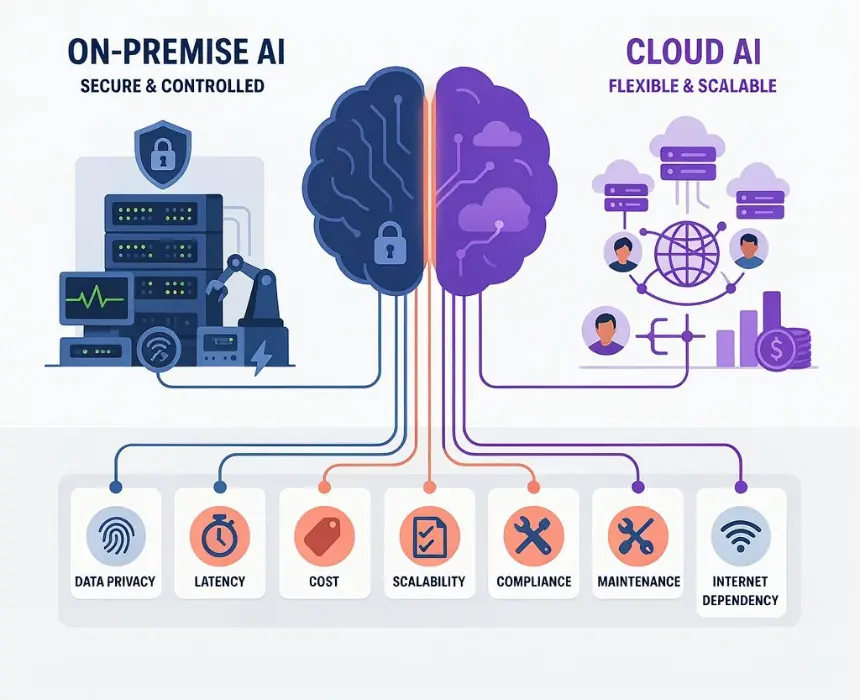
A model architecture appropriate for a cloud API with 500ms latency tolerance is completely wrong for an embedded MCU that needs to run inference in 10ms with 256KB of RAM. We design AI systems for the deployment target from the start — whether that is a cloud endpoint, a mobile app, an IoT gateway, or bare-metal embedded hardware.
Most AI projects underdeliver because the data was not ready and nobody said so until six months into development. We assess your data for volume, quality, labelling coverage, and real-world representativeness before committing to a training approach and we tell you what needs to change if the data is not there yet.
The first question we ask is what business decision this AI system needs to support - not which model architecture to use. Model selection follows problem definition. Teams that start with the model tend to build solutions looking for a problem.
We offer embedded systems, IoT, app development services along with AI - ML development.
We develop custom mobile app in IoT, wearables, healthcare in android, iOS and cross platform.
More DetailsWe develop custom web app for industries like healthcare, manufacturing, consumer electronics products etc.
More DetailsWe develop custom IoT hardware, IoT firmware, IoT apps and AIoT integration services.
More DetailsWe develop custom IoT firmware, OTA integration, linux and RTOS based development, BSP development, hardware-firmware integration, kernel and bootloader development.
More DetailsWe develop custom hardware, from schematic design to layout design, BOM optimization, EOL management and hardware design review.
More DetailsA structured, milestone-driven AI development process from problem definition through to production deployment and ongoing performance management. We build things that ship - not slide decks about AI potential.
1
We start by understanding the specific business problem AI is being applied to - what decision it needs to support, what accuracy it needs to achieve, and what happens when it gets it wrong. We assess your existing data for volume, quality, labelling coverage, and representativeness of the real-world distribution the model will face. If your data is not ready for training, we tell you that here - not after three months of development.
2
We design the AI system architecture - model approach, training strategy, feature engineering plan, data pipeline design, inference infrastructure, and integration points with your existing systems. We benchmark candidate approaches on a sample of your data before committing to a full training run. Model selection decisions are documented with the trade-offs between accuracy, latency, cost, and maintainability clearly articulated.
3
We prepare the data the model needs - collection workflows, labelling processes for supervised learning tasks, feature engineering code that transforms raw data into model inputs, and data validation that catches quality issues before they affect a training run. Data preparation work is version-controlled and documented so every training run can be traced back to the exact dataset it used.
4
Training runs are tracked with full experiment reproducibility. We evaluate models against business metrics — not just accuracy scores — and conduct error analysis to understand where the model fails and why. For generative AI work we run structured human evaluation alongside automated metrics to assess output quality against your specific requirements.
5
We deploy models as REST APIs, streaming inference endpoints, or embedded modules depending on your latency and throughput requirements - on AWS SageMaker, GCP Vertex AI, Azure ML, or self-hosted infrastructure. Integration with your existing systems - web apps, mobile apps, IoT platforms, embedded devices - is tested end-to-end before production release.
6
We set up model performance monitoring that tracks prediction quality, data drift, and system latency in production. We define retraining triggers and build automated retraining pipelines where the data volume and update frequency justify them. AI systems that are not monitored degrade silently - we make sure yours does not.


Yes — AI integration is one of our most common engagement types. For software platforms we build model serving APIs, integrate streaming LLM responses into web and mobile frontends, add recommendation and personalisation layers to existing products, and insert ML scoring into existing data pipelines. For hardware products we deploy on-device AI models on embedded MCUs and IoT gateways, implement Edge Impulse sensor data classifiers on Nordic and STM32 hardware, and build AWS Greengrass and Azure IoT Edge workloads that run inference locally before transmitting results to the cloud. Integration work always starts with an assessment of the existing system architecture to identify the cleanest integration points.
Retrieval-Augmented Generation connects an LLM to a searchable knowledge base at inference time - the model retrieves relevant documents and uses them as context when generating a response. Fine-tuning bakes domain-specific knowledge or behaviour into the model weights through additional training. RAG is the right choice when your knowledge base changes frequently, when you need citations and source traceability, or when the volume of domain knowledge is too large to fit in a context window. Fine-tuning is better when you need to change how the model behaves - its tone, format, or reasoning approach or when you are working with a specific task that benefits from task-specific training examples. Most production LLM applications use both: fine-tuning for behaviour and RAG for knowledge.
Yes, always. We sign a mutual NDA before any technical discussion begins. Your use case, data, model architecture, and business model are fully protected throughout the engagement. All training code, model weights, data pipelines, and deployment infrastructure are transferred to you at project completion -you retain 100% ownership of everything we build.
Yes - on-device and edge AI deployment is one of our specialist capabilities. We deploy ML models on STM32 microcontrollers using STM32Cube.AI, on Nordic nRF52 platforms using Edge Impulse SDK, on NVIDIA Jetson hardware using TensorRT, and on mobile devices using TensorFlow Lite and Apple Core ML. On-device deployment requires model compression - quantisation, pruning, and knowledge distillation - to fit accuracy requirements within the memory and compute constraints of the target hardware. We manage this trade-off as part of the model development process, not as an afterthought after the model is too large to deploy.
We develop custom AI systems across machine learning, deep learning, generative AI, natural language processing, and computer vision - for both software products and physical hardware including mobile apps, IoT devices, and embedded systems. Use cases we have built for include demand forecasting, customer churn prediction, document intelligence, conversational AI, defect detection in manufacturing, medical image analysis, recommendation engines, on-device voice command recognition, and real-time sensor anomaly detection. If the use case involves learning from data to make predictions or decisions, we can build it.