- April 07, 2026
Summarize with AI
Not enough time? Get the key points instantly.
Get summary:
Why Challenges Occurs in Medical Wearable Device Development?
A team builds a working prototype, the sensor readings look clean on the bench, and the demo goes well with a hospital partner. Six months later, the same team is fighting inconsistent readings the moment a patient walks around, a board that doesn't fit the enclosure they actually need, and a battery life complaint from every early user. Medical wearable device development challenges rarely come from a weak idea - they come from engineering decisions made in the wrong order, or not made at all until they became a crisis.
This post walks through the 12 medical wearable device development challenges that actually determine whether a product reaches production, and what to do about each one before it becomes expensive to fix.
Why Medical Wearables Fail in Execution, Not the Idea
Most teams start medical wearable device development thinking it's a sensor-plus-app problem. It isn't. A medical wearable has to hold clinical-grade accuracy on a moving body, survive being worn for days at a time, fit comfortably enough that a patient doesn't take it off in week two, and manufacture consistently at volume.
Each of those requirements pulls against the others. Better sensor accuracy often costs more power. A smaller, more comfortable form factor constrains the PCB layout and antenna design. A wireless link tuned for range costs battery life a patient will notice. None of these challenges is unsolvable on its own - the failure mode is treating them as separate engineering problems instead of trade-offs that have to be resolved together, and early.
12 Medical Wearable Device Development Challenges
Challenge 1: Data Accuracy Across Real-World Conditions
Sensor readings that look clean on a bench often degrade the moment they meet motion, sweat, and the full range of skin tones a real population has. Optical sensors in particular are sensitive to skin melanin content and placement pressure, which means a device validated on a narrow test group can perform noticeably worse in the field.
Validate across a genuinely diverse test population — not a convenience sample of the engineering team
Use multi-sensor fusion where the budget allows — combining optical and mechanical sensing reduces reliance on any single signal that can degrade under motion
Build continuous calibration into firmware, not just factory calibration, since sensor performance drifts over the device's wear life
Challenge 2: Filtering Motion Artifacts Out of the Signal
Motion is the single biggest source of noise in continuous wearable sensing - a PPG (optical heart rate) signal gets swamped by motion artifacts the moment a patient walks, types, or rolls over in bed. Motion artifact filtering wearable sensors depend on is exactly what separates a device that stays clinically useful during activity from one that only performs well while the wrist is still, which is rarely how patients actually wear it.
Technique | What it does | Trade-off |
|---|---|---|
Accelerometer referenced filtering | Uses motion data to subtract movement-correlated noise from the signal | Adds compute load and a second sensor's power draw |
Adaptive filtering (e.g. LMS) | Continuously adjusts filter coefficients as motion patterns change | More complex to tune and validate than a fixed filter |
Signal quality gating | Flags and discards data below a confidence threshold instead of correcting it | Simpler to implement, but creates gaps in continuous data |
Most production-grade wearables combine at least two of these — gating out the worst segments while actively filtering the rest rather than relying on a single technique to handle every real-world motion pattern.
Challenge 3: Building a Secure Data Pipeline Without Adding Latency
A medical wearable streaming health data to a phone and a cloud backend is a bigger attack surface than most consumer devices, and security bolted on after the data pipeline already works tends to either leave gaps or add enough latency that users notice. Encryption, authentication, and secure storage need to be part of the architecture at every hop - device to phone, phone to cloud designed alongside the data pipeline itself, not layered on top of it afterward.
Building this in from the start is also what keeps security from becoming a battery and performance tax later - retrofitted encryption on an already-tight power budget is a much harder problem than designing for it from day one.
Challenge 4: Battery Life That Survives Continuous Monitoring
Continuous sensing, wireless transmission, and processing all draw power, and a device that needs daily charging breaks the continuous monitoring that gives medical wearables their clinical value. The communication protocol choice alone can be the difference between days and hours of battery life.
Protocol | Typical Power Draw | Best fit |
|---|---|---|
BLE (Bluetooth Low Energy) | Low - designed for intermittent small payload transmission | Most consumer facing medical wearables |
Zigbee/ Thread | Low medium - better for mesh, less common in consumer wearables | Multi device home health setups |
Cellular (NB-IoT/LTE-M) | Higher - but removes the phone-pairing dependency | Standalone devices without a paired smartphone |
On-device processing that reduces how often raw data needs transmitting, combined with adaptive power modes that scale sensing frequency to what's actually needed, is where most wearable device battery life optimization gains come from - typically more than any single hardware upgrade delivers on its own.
Challenge 5: Getting Wearable Data Into a Format Clinicians Can Use
Data trapped inside a proprietary app never reaches a clinician's actual workflow. Structuring wearable output around established healthcare data formats like FHIR is what lets it flow into an electronic health record instead of living in an app nobody in the care team ever opens.
Planning this data structure from the start, rather than building a proprietary format and translating later, is an integration decision, not a compliance one — and it avoids a rebuild once a hospital partner asks for real system integration.
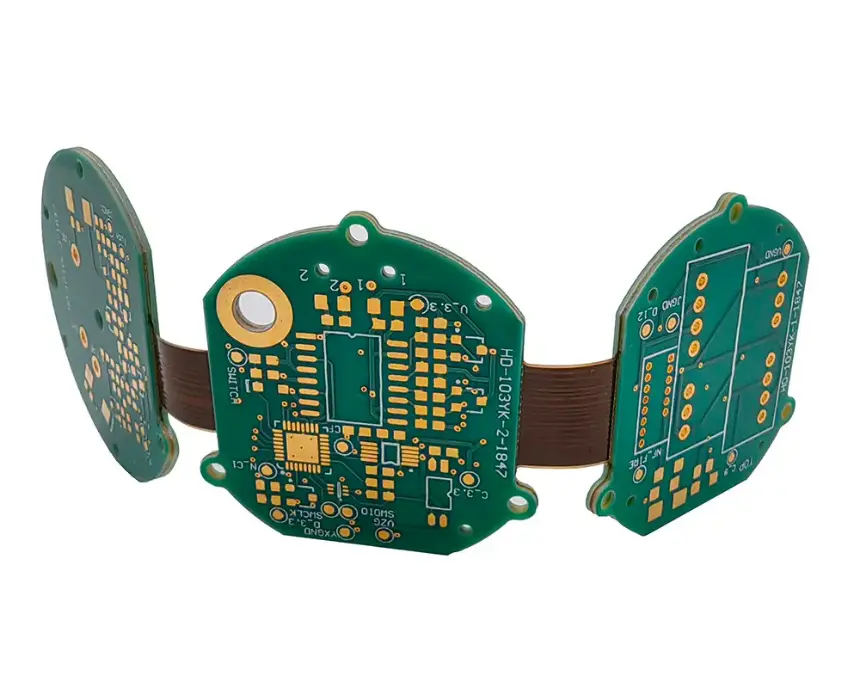
Challenge 6: Designing a Flexible PCB That Survives Being Worn
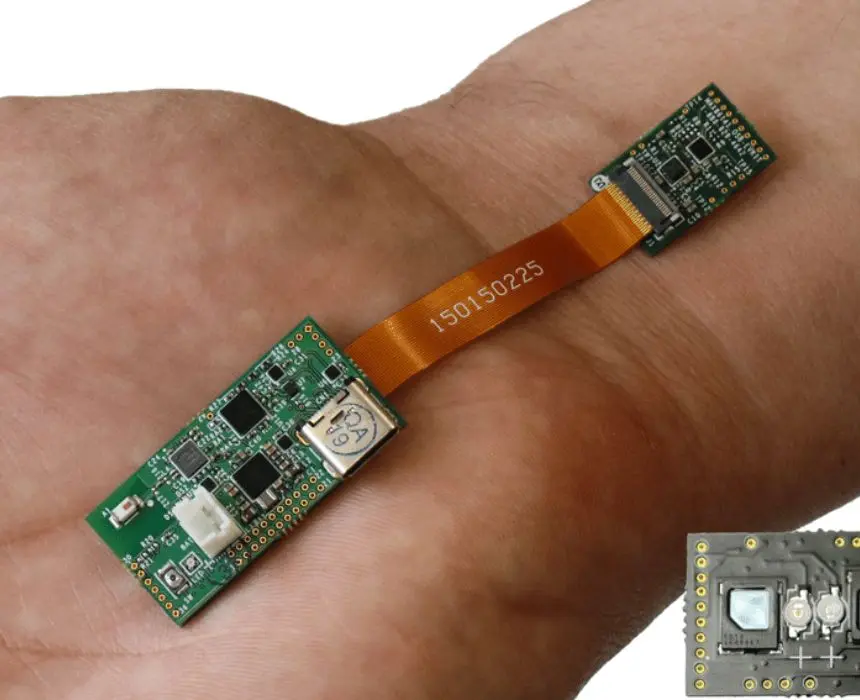
A rigid board doesn't bend with a wrist or a chest strap, which is why flexible PCB design for wearables — using flex or rigid-flex substrates — matters as much as component selection for anything worn against a moving body. Flex PCBs bring their own constraints: trace routing has to account for repeated bending stress, and component placement needs to avoid high-flex zones where solder joints are most likely to fail over time.
Route traces perpendicular to the bend axis where possible, since parallel routing concentrates stress on individual traces
Keep rigid components out of the highest-flex zones — put connectors and larger ICs on rigid sections of a rigid-flex board
Fatigue-test the board through realistic bend cycles, not just a single flex test, since a board that survives one bend can still fail after thousands of wear cycles
Challenge 7: Comfort That Holds Up Over Days, Not Minutes
A device tested for comfort during a 20-minute demo tells you very little about how it feels after 18 hours of continuous wear. Discomfort, skin irritation, or a form factor that shifts during sleep are why devices get taken off — and a device that isn't worn generates no data at all.
Material/Form Factor | Multi-Day Wear Comfort | Common Failure Mode |
|---|---|---|
Rigid plastic housing, fixed band | Lower — pressure points on prolonged contact | Skin irritation, pressure marks over time |
Silicone band, rigid module | Better — flexible contact surface | Sweat trapping if ventilation is poor |
Flexible/textile-integrated form factor | Best for extended wear | More complex manufacturing and sealing |
Test wear comfort over multi-day periods, not single sessions, with real users in real conditions like sleep and exercise
Use skin-safe, breathable materials validated for extended contact, not just materials that pass a one-time biocompatibility check
Design for different body types and wear positions, since a form factor optimized for one wrist size or skin type won't generalize automatically
Challenge 8: Managing Firmware Updates Across a Device Fleet
A medical wearable's firmware improves after launch as bugs get found and algorithms get better, and a device without a reliable OTA (over-the-air) update path means every improvement stays stuck at whatever shipped on day one. The update mechanism needs a tested rollback path for failed updates and power-loss recovery, since a bricked wearable is a support call, not a quick fix, for a device a patient is depending on.
Challenge 9: Controlling Cost Without Compromising the Product
Between clinical-grade components, custom sensor packages, and hardware production, medical wearable costs escalate quickly, and teams that don't manage this early either run out of runway or ship a device priced out of its market. A phased approach — off-the-shelf components for early validation, custom hardware only where it earns its cost - keeps early iteration cheap while reserving custom investment for the parts of the design that actually differentiate the product.
Challenge 10: Keeping Algorithm Accuracy Consistent Across Users
An algorithm trained on a narrow dataset produces uneven accuracy across skin tones, ages, body types, and activity levels — a real engineering problem, not just a fairness concern, since inconsistent accuracy undermines the core value of the device. Medical wearable data accuracy claims only hold up if the validation dataset actually reflects the population the device will serve, not the population that was easiest to recruit for testing.
Running accuracy checks against demographic and activity subgroups on an ongoing basis, not just once at launch, catches drift that a single validation pass won't.
Challenge 11: Managing Heat in a Device Worn on Skin
A wearable sitting directly against skin has very little room to dissipate the heat generated by continuous sensing, processing, and wireless transmission, and unmanaged thermal load causes discomfort at minimum and a safety issue at worst. Running thermal simulations early in the hardware design phase — not after the first physical prototype overheats catches this before it becomes a redesign.
Challenge 12: Scaling From Working Prototype to Reliable Manufacturing
A device that works reliably as a hand-built prototype often reveals new problems - inconsistent sensor calibration, assembly variability, flex-PCB yield issues — the moment it moves to volume production. Scaling wearable device manufacturing successfully means designing for it early: modular architecture, standardized components, and automated calibration and quality checks built into the process before the first production run, not added after yield problems show up.
Where to Focus First: A Priority Checklist
Not all medical wearable device development challenges carry equal weight at every stage. Before locking your hardware architecture, confirm:
Has the sensor validation plan been built around a genuinely diverse population and range of motion conditions?
Does the signal processing pipeline actively filter motion artifacts, or just flag and discard bad data?
Is security designed into the data pipeline's first version, not added as a separate pass before launch?
Does the communication protocol and power strategy support the wear time your use case actually requires?
Has the PCB been fatigue-tested through realistic bend cycles if it's a flex or rigid-flex design?
Is there a tested OTA update path with rollback, or does every firmware bug stay stuck at what shipped?
Solving These Together, Not One at a Time
The 12 challenges above aren't independent problems to solve in sequence - they're engineering trade-offs that have to be resolved together, starting with sensor and signal processing architecture before the PCB and enclosure lock in. Working through medical wearable device development challenges this way, as connected trade-offs rather than a checklist, is what separates teams that ship devices holding up in the field from teams that rebuild the same component two or three times. If you're scoping a medical wearable and want a second opinion on where your current design stands against these 12 challenges, CoreFragment's team can review your architecture and flag what needs attention first.
Author
Have Something on Your Mind? Contact Us : info@corefragment.com or +91 79 4007 1108

Related articles

_title.webp)